IT Disaster Recovery
Disaster recovery (DR) involves a set of policies and procedures to enable the recovery or continuation of vital technology infrastructure and systems following a natural or human-induced disaster. Disaster recovery focuses on the IT or technology systems supporting critical business functions, as opposed to business continuity, which involves keeping all essential aspects of a business functioning despite significant disruptive events. Disaster recovery is therefore a subset of business continuity.
Control measures
Control measures are steps or mechanisms that can reduce or eliminate various threats for organizations. Different types of measures can be included in disaster recovery plan (DRP).
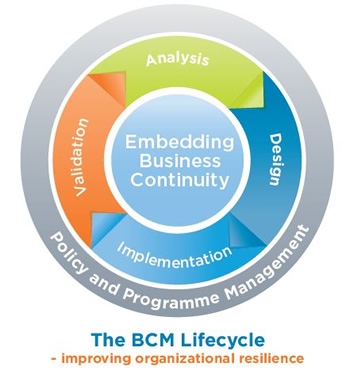
Disaster recovery planning is a subset of a larger process known as business continuity planning and includes planning for resumption of applications, data, hardware, electronic communications (such as networking) and other IT infrastructure. A business continuity plan (BCP) includes planning for non-IT related aspects such as key personnel, facilities, crisis communication and reputation protection, and should refer to the disaster recovery plan (DRP) for IT related infrastructure recovery / continuity.
IT disaster recovery control measures can be classified into the following three types
- Preventive measures – Controls aimed at preventing an event from occurring.
- Detective measures – Controls aimed at detecting or discovering unwanted events.
- Corrective measures – Controls aimed at correcting or restoring the system after a disaster or an event.
Good disaster recovery plan measures dictate that these three types of controls be documented and exercised regularly using so-called “DR tests”.
Managed Storage Services
Data is one of the most mission-critical components of your business, and you want to ensure that it’s always available when you need it. No matter how fast your business grows and evolves, we’ll make sure that you always have the right solution for your capacity and performance needs.
From dedicated Storage Area Network (SAN) to Cloud Object storage, our managed storage services provide access to on-demand storage and support for your applications with no upfront capital investment.
We provide consulting for DIY NAS solution is designed to support demanding workloads, like virtualization, file sharing and rich media. NAS scales up to an amazing TBs to PBs of capacity.
Our Team for consulting provides High-end SAN solution offers high availability and reliability by leveraging a fully redundant architecture for business-critical applications. This SAN solution scales easily as your capacity demands grow.
Backup & Data Protection
Continuous data protection (CDP), also called continuous backup or real-time backup, refers to backup of computer data by automatically saving a copy of every change made to that data, essentially capturing every version of the data that the user saves. It allows the user or administrator to restore data to any point in time. The technique was patented by British entrepreneur.
CDP runs as a service that captures changes to data to a separate storage location. There are multiple methods for capturing the continuous changes involving different technologies that serve different needs. CDP-based solutions can provide fine granularities of restorable objects ranging from crash-consistent images to logical objects such as files, mail boxes, messages, and database files and logs.
Intelli-Help provides comprehensive protection of organizations’ business-critical data assets while helping them to remain in compliance with both general and industry-specific regulations. We offer a choice of data protection solutions that can be implemented onsite, or at multiple geography located data centers. << Our Organization>> staffed by teams of cloud experts who are fluent in the latest security threats. They are powered by the latest data protection technologies including advanced encryption and data deduplication practices to help organizations protect data, maintain compliance and minimize risk.
Leveraging any cloud-based data protection solutions, organizations can maintain their applications and data assets within an efficient, cost-effective environment. Further, our backup management consulting also offer more predictable operating expenses and reduced upfront CAPEX. We save organizations time and expense by providing centralized visibility into five critical aspects of their cloud environments – availability, performance, security, recovery and capacity.